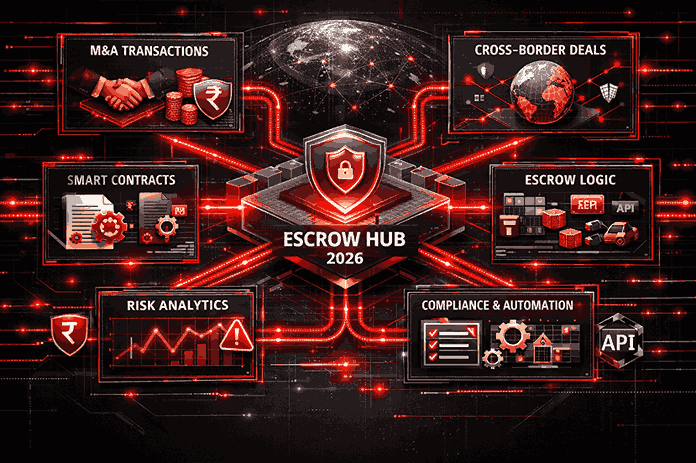
Escrow is revolutionizing business transactions by 2026 with secure payments based on milestones, thus eliminating fraud, disputes, and risks associated with counterparty transactions.
Escrow introduces a third-party element that is trustworthy and enhances compliance, transparency, and trust in business transactions.
Table of Contents:
How Is Escrow Transforming Enterprise Transactions by 2026 in Real Business Scenarios?
Why this matters for enterprises
Why Are Enterprises Moving Away From Traditional Payment Models Toward Escrow?
Escrow vs traditional payments
How Do Modern Escrow Platforms Actually Work in Enterprise Deals?
Which Types of Enterprise Transactions Benefit Most From Escrow?
How Does Escrow Reduce Fraud and Payment Disputes in Enterprise Deals?
How Is Escrow Supporting Cross-Border Enterprise Transactions in 2026?
What Technologies Are Powering Escrow Platforms by 2026?
What Should Enterprises Consider Before Implementing Escrow?
Conclusion
FAQs
How Is Escrow Transforming Enterprise Transactions by 2026 in Real Business Scenarios?
Escrow is transforming enterprise transactions by 2026 by adding a neutral, automated payment layer that releases funds only when contract terms are met. This reduces fraud, improves trust, and speeds up global business deals.
Key changes enterprises are seeing
Payments are released based on milestones, not promises
Reduced disputes between vendors and clients
Automated compliance and audit trails
Faster cross-border deal execution
Increased trust with new partners
Why this matters for enterprises
| Factor | Before Escrow Adoption | With Escrow in 2026 |
| Payment security | High risk | Funds protected |
| Trust level | Low with new vendors | High with neutral holding |
| Deal speed | Slow | Faster automation |
| Compliance | Manual | Built-in tracking |
Why Are Enterprises Moving Away From Traditional Payment Models Toward Escrow?
Enterprises are moving toward escrow because traditional payment systems expose them to fraud, delivery failure, and payment disputes.
Main problems with old models
Upfront payments without guarantees
Long invoice cycles
Chargebacks and legal disputes
Lack of delivery accountability
Escrow vs traditional payments
| Feature | Traditional Payment | Escrow Payment |
| Risk for the buyer | High | Low |
| Risk for the seller | High | Low |
| Dispute resolution | Legal heavy | Automated |
| Transparency | Limited | High |
Many fintech teams now embed escrow directly into platforms instead of relying on manual contracts.
This shift is strongly driven by the rise of escrow in embedded finance, where payment security is built directly into digital platforms.
How Do Modern Escrow Platforms Actually Work in Enterprise Deals?
Modern escrow platforms hold funds in a secure account and release them automatically when predefined milestones are completed.
Typical workflow
Example process table
| Step | Action | Who controls it |
| 1 | Contract created | Buyer & seller |
| 2 | Funds locked | Escrow platform |
| 3 | Work delivered | Vendor |
| 4 | Approval given | Buyer |
| 5 | Payment released | Automated |
Platforms like Stripe and PayPal have influenced how embedded escrow works inside digital platforms.
Which Types of Enterprise Transactions Benefit Most From Escrow?
High-value, milestone-based, or cross-border transactions benefit most from escrow protection.
Top use cases
Enterprises handling global transactions increasingly rely on cross-border payments with escrow to reduce risk and ensure compliance.
Industry impact table
| Industry | Escrow use | Benefit |
| SaaS | Milestone payments | Delivery assurance |
| Real estate | Property deals | Secure funds |
| E-commere | Buyer protection | Trust |
| Logistics | Shipment payments | Verified delivery |
Marketplaces like Alibaba popularized escrow-style buyer protection globally.
This buyer-protection structure closely mirrors modern escrow in eCommerce frameworks used across digital marketplaces.
How Does Escrow Reduce Fraud and Payment Disputes in Enterprise Deals?
Escrow reduces fraud by holding funds until both parties meet contractual obligations and by providing a transparent audit trail.
Fraud reduction mechanisms
Fraud comparison
| Scenario | Without Escrow | With Escrow |
| Vendor disappears | Money lost | Funds returned |
| Delivery delayed | Dispute | Payment paused |
| Quality issues | Hard to resolve | Funds held |
How Is Escrow Supporting Cross-Border Enterprise Transactions in 2026?
Escrow enables safe international transactions by handling currency risk, compliance checks, and payment timing between global partners.
Benefits for global deals
Cross-border escrow value
| Challenge | Escrow solution |
| Unknown vendor | Neutral holding |
| Currency risk | Locked rate |
| Payment timing | Conditional release |
| Compliance | Automated checks |
For regulated international trade environments, many enterprises compare escrow vs letter of credit to determine the most efficient settlement structure.
What Technologies Are Powering Escrow Platforms by 2026?
Escrow platforms now use APIs, AI, and smart contracts to automate verification, risk checks, and payment release.
Core technologies
API-based integration
Smart contracts
AI fraud detection
Automated compliance
Real-time dashboards
Technology stack overview
| Technology | Role |
| APIs | Platform integration |
| AI | Risk scoring |
| Smart contracts | Auto release |
| Cloud systems | Scalability |
What Should Enterprises Consider Before Implementing Escrow?
Enterprises should evaluate transaction risk, integration complexity, and compliance requirements before adopting escrow.
Implementation checklist
Decision table
| Question | Why it matters |
| Transaction value high? | Escrow recommended |
| Cross-border involved? | Strongly recommended |
| Multiple milestones? | Ideal use case |
| Compliance-heavy? | Escrow helps |
Conclusion
By 2026, escrow will have become a core infrastructure layer for enterprise payments. It builds trust, reduces fraud, and enables faster global transactions. Companies adopting escrow aren’t just protecting payments — they’re establishing reliable and scalable business relationships.
Frequently Asked Question
Why are enterprises increasing their use of escrow in 2026?
Because digital deals require trust, automation, and secure payment structures.
Does escrow slow down transactions?
No. Automation actually speeds up payment release once conditions are met.
Is escrow only for large companies?
No. Startups and marketplaces also use embedded escrow systems.
Can escrow work for SaaS contracts?
Yes. It’s widely used for milestone-based software development.
Is escrow safe for cross-border payments?
Yes. It protects both parties and ensures compliance.
Will escrow become standard in enterprise finance?
Yes. It’s becoming a default layer for high-value digital transactions.